
Knowledge & Trends
SAP CDS views: combining real-time analytics & transactions

Blog post
Have you ever been frustrated by slow reports that run on yesterday’s data? Or does your department struggle because the numbers in operational procurement don’t match the management reports?
In many SAP landscapes, there is a strict separation: on one side, the transactional system for day-to-day operations, and on the other, complex data warehouses for analytics. The result is data silos, delays, and high maintenance effort.
With SAP Core Data Services (CDS), SAP breaks down these barriers. SAP CDS views form the modern, high-performance foundation of an S/4HANA system. They connect application development with state-of-the-art business intelligence (BI) in real time, all on a single, consistent data foundation (single source of truth).
More than just tables: enriching and calculating data via code pushdown
An SAP CDS view is far more than a classic database view. It acts as an intelligent semantic layer in which data is refined right at the source. Instead of laboriously gathering and calculating data through classic ABAP code on the application server, CDS shifts this logic directly onto the powerful SAP HANA in-memory database through the principle of code pushdown.
The framework gives developers and BI consultants powerful tools that work entirely without imperative ABAP programming effort. Instead of complex programming logic, data refinement is defined purely declaratively:
▷ Calculations and conditions
Mathematical operations, string concatenations, or complex case distinctions (CASE WHEN conditions) are defined directly in the CDS view and calculated by the database at top speed.
▷ Intelligent joins (associations)
Instead of rigid, hard-wired database joins, CDS views use so-called associations. These work like a “join on demand”: they define the relationship between tables architecturally in advance. However, the HANA database only executes the join at runtime when the user actually requests the fields of the linked table in the report or app. This saves valuable system resources for flexible ad-hoc queries and prevents unnecessary data overhead.
The Virtual Data Model (VDM): investment protection through a three-tier architecture
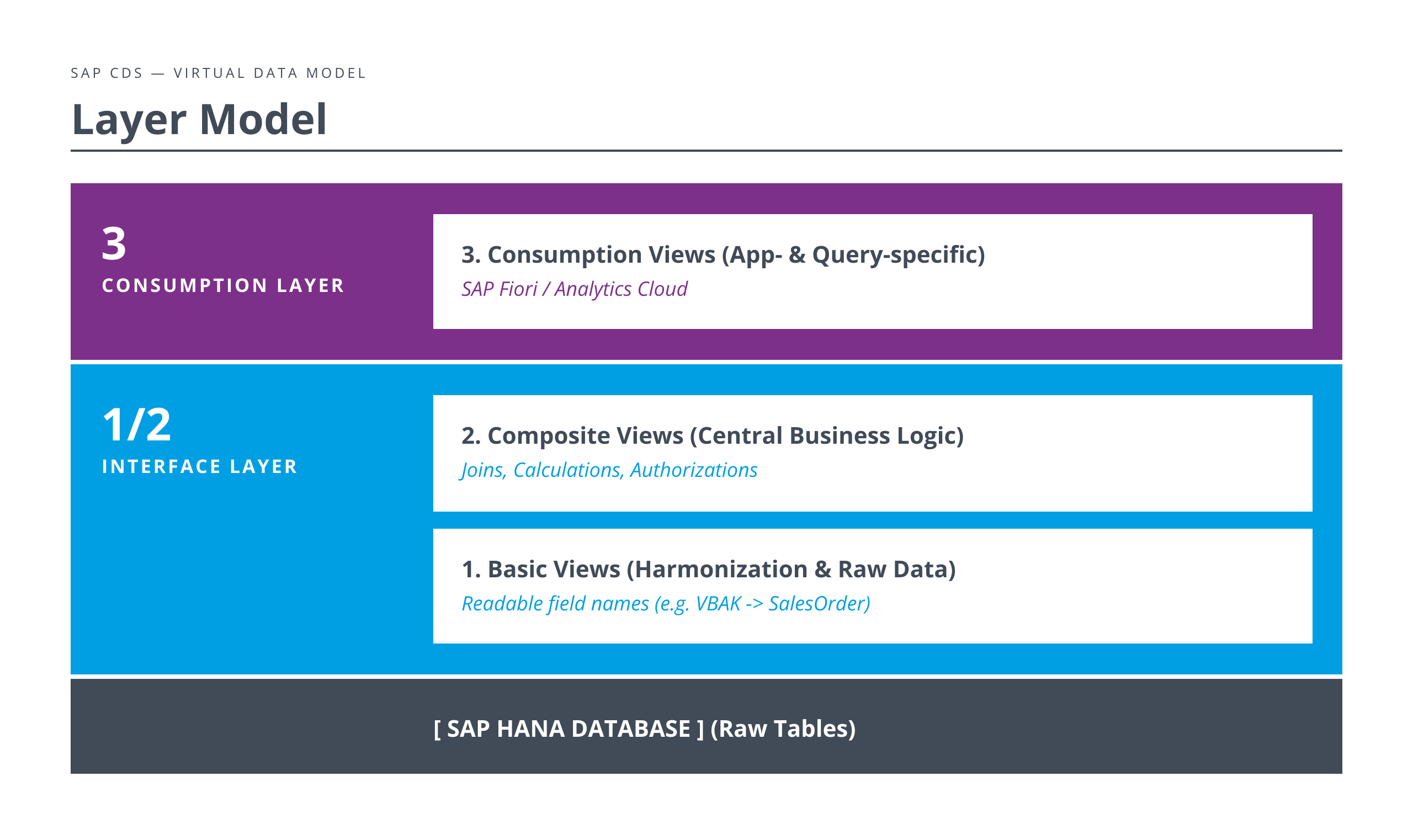
To keep the system organized in the long term, CDS views are stacked hierarchically in the so-called Virtual Data Model (VDM). This strict separation into two main layers (interface and consumption), with the interface layer subdivided strategically, is the most important lever for maintainability and upgrade safety:
1. Basic views (the data source)
This layer accesses the cryptic SAP standard tables directly (e.g., VBAK for sales orders). Here, technical fields are given understandable names and data types are harmonized.
2. Composite views (the business logic)
Together with the basic views, this layer forms the higher-level interface layer. This is where business knowledge is anchored: the basic views are linked to each other, calculations are performed, and global authorizations are defined.
3. Consumption views (the application layer)
This top layer is tailored precisely to the specific use case, whether for an interactive SAP Fiori application or an analytical BI query.
A practical example of the benefits of the VDM
Imagine that SAP changes an internal standard database table during a future S/4HANA upgrade. Without a structured VDM, you would have to touch dozens of custom apps and BI reports one by one and correct them manually.
Thanks to the VDM architecture, your consultants make the change just once, centrally in the basic layer. The business logic above it and all connected dashboards or Fiori apps keep running without errors right away.
The fork in the road: where app development and BI part ways
Although CDS views bridge the gap between development and business intelligence, true architectural expertise shows at the consumption level. A transactional application works in a structurally different way than an analytical report: while the app thinks in individual documents (locking, changing, saving), reporting needs multidimensional datasets, aggregates, and key figures.
The VDM therefore uses a shared foundation at the basic and lower interface levels, but then splits strategically:
▷ The transactional branch:
Specific UI and behavior annotations come into play here, for example to seamlessly control input screens or the integrated draft handling for SAP Fiori Elements apps.
▷ The analytical branch
For high-performance reporting, our BI experts equip the upper layers with dedicated analytics annotations. The view is deliberately defined as a multidimensional data cube (@Analytics.dataCategory: #CUBE), and the key figures (e.g., revenue) are separated from the dimensions (e.g., region). At the top level, this creates a true analytical query (@Analytics.query: true), which serves as a high-performance live data source for SAP Embedded Analytics, the Analytical List Page (ALP), or SAP Analytics Cloud (SAC). Time-consuming loading processes (ETL) into a separate data warehouse are eliminated entirely.
Clean core: extending the SAP standard without the pain of modifications
A huge advantage in day-to-day project work is how well the concept can be extended. SAP’s standard delivery often already includes ready-made CDS views, but the business unit is missing an important customer-specific field.
Through CDS extensions, we cleanly hook new fields into the existing standard view. The core of the system remains completely untouched (clean core strategy). The standard is not modified, and your customer-specific extension is guaranteed to survive any future system upgrade unscathed.
Important: without clean modeling, the SAP HANA speed boost fizzles out
From our day-to-day experience, we know, however, that SAP CDS views are not an automatic cure-all for general performance problems. If the views are poorly modeled from a craftsmanship standpoint, the HANA speed boost fizzles out completely.
One critical success factor, for example, is the placement of filters. If data volumes are only filtered at the top level (consumption), the database often has to process millions of rows unnecessarily in the background.
Experienced consultants make sure that filters take effect as early as possible at the lower layers, so that they work with small, high-performance subsets. Incorrectly nested joins or circular dependencies can also quickly bring a system to its knees. This is where architectural know-how determines success or frustration in day-to-day operations.
Best Practices
For a high-performance CDS architecture
▷ Stick strictly to the VDM standard
Never build consumption views directly on raw tables. Adhering to the layered architecture is your insurance policy for the next SAP upgrade.
▷ Separate transactional and analytical views
Use the shared foundation, but build dedicated queries with the appropriate analytics annotations for BI requirements.
▷ Filter data as deep as possible
Reduce the data volume through smart filter placement at the lower layers to take the load off the HANA database as much as possible.
▷ Use associations instead of hard joins
Conserve system resources by defining links defensively as associations. Data only flows when the user actually requests it.
Conclusion
The single source of truth for your company.
SAP Core Data Services are far more than just a tool for querying data. They are the fundamental link between modern application development and real-time operational analytics. Those who build CDS views with the right architecture and master the key decisions between transactional and analytical annotations eliminate inconsistent sets of numbers, save valuable development time, and sustainably relieve the burden on support.
Author: Alisa Reckinger | Last updated: 07/30/2026