
Knowledge & Trends
S/4HANA meets SAP Datasphere: CDS, ODP, or Replication Flow—the right path for your data

Blog post
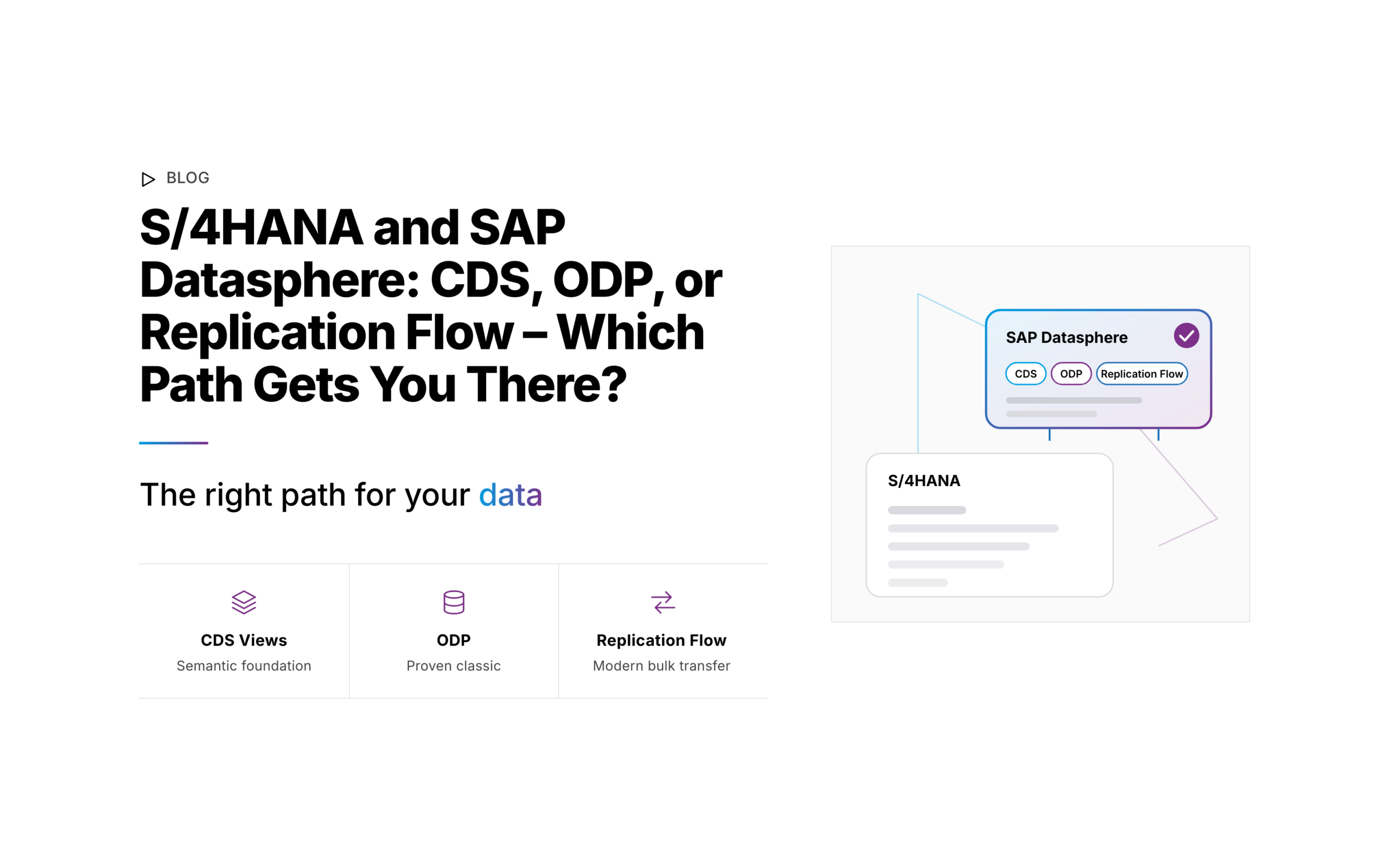
Your S/4HANA system is the heart of your business processes, but the valuable data in it only unfolds its full benefit when it is available for analytics reliably, up to date, and in an understandable form. With SAP Datasphere as part of SAP Business Data Cloud, SAP has created the central data platform that is meant to do exactly that: bring together data from SAP and non-SAP sources, enrich it with business semantics, and make it usable for reporting, planning, and AI scenarios.
At the latest in the first project workshop, however, the decisive question comes up: how does the data get from S/4HANA to Datasphere? CDS views, ODP, replication flow, remote tables: all these terms come up quickly, but the differences are hard to grasp at first glance. Yet this architecture decision has a direct impact on performance, data freshness, license costs, and the long-term maintainability of your data landscape.
Three terms that are often confused
A common misunderstanding from practice: CDS, ODP, and replication flow are viewed as equivalent alternatives. In fact, they operate at different levels and often work together:
1. CDS views, the semantic foundation
Core Data Services are not a transport route, but the modern data model of S/4HANA. Released, extraction-enabled CDS views deliver the business data already prepared from a business perspective, including texts, hierarchies, and relationships and, if desired, with delta functionality as well. In most modern scenarios, they form the actual data source.
2. ODP, the proven classic
The Operational Data Provisioning framework comes from the BW world and is known to anyone who has ever extracted data from SAP systems. It enables the use of classic extractors (DataSources) and existing BW objects, including delta procedures. Ideal when extensive BW investments already exist.
3. Replication flow, the modern bulk transport
Replication flows are SAP’s tool for replicating large volumes of data to Datasphere with high performance, with initial load and delta transfer via change data capture. In addition, data can also be forwarded to external targets, such as cloud storage or streaming platforms. Replication flows can build on both CDS views and ODP DataSources as sources and pick up data through them.
In addition, there are remote tables, through which data can be read virtually, that is, without a physical copy, directly from the source system. The art lies in choosing the right path for each data object.
Live access or replication? The fundamental question first
Before it comes to technologies, there is a strategic decision: should the data be queried virtually or stored physically in Datasphere? Virtual access shines with up-to-the-day or real-time data and saves storage, but puts load on the productive S/4HANA system with every query and, especially in more complex use cases, can also lead to restrictions in query performance. Replication cleanly decouples analytics and transactions, but requires a well-thought-out delta concept in return.
From our projects, we know: the best solution is almost never a pure “either-or.” Small master data objects can be connected virtually very well, while transactional data such as accounting documents or sales items should, as a rule, be replicated. Which mix is optimal for your landscape depends on data volume, freshness requirements, and system load, and can be assessed systematically.
Typical stumbling blocks and why they are solvable
In practice, Datasphere projects rarely fail because of the platform itself, but because of details that are underestimated at the beginning:
▷ Missing delta capability
Not every CDS view is prepared for delta extraction out of the box. Without delta, every data transfer becomes a full load, with noticeable consequences for runtimes and system load. With the right know-how, however, your own delta-capable views can be built deliberately and in an upgrade-safe way.
▷ Classic extractors in S/4HANA
Not all extractors known from ECC are still released or sensibly usable in S/4HANA. Anyone who migrates 1:1 quickly builds up technical debt. It is worth looking at the suitable CDS alternatives here.
▷ Mass data during the initial load
Tables such as the Universal Journal (ACDOCA) quickly reach billions of records. Without partitioning and sensible parallelization, the initial load process becomes a test of patience. With the right configuration, however, it becomes plannable.
▷ License and cost traps
SAP has restricted the use of the ODP interface by third-party tools, and forwarding data to external targets via replication flow is also cost-relevant. Anyone who plans their data flows early in a license-compliant way avoids unpleasant surprises.
▷ Connectivity and authorizations
Cloud Connector, Data Provisioning Agent, or communication scenarios in S/4HANA Cloud: depending on the system landscape, different connection paths are needed. A clean setup is the foundation for stable operation.
Existing BW and the future with SAP Business Data Cloud
Many companies still run an SAP BW today with logic that has grown over many years. Through ODP connections, the SAP BW Bridge, or step-by-step migration approaches, existing know-how can be carried over into the new world, while new scenarios build directly on CDS views and replication flows.
At the same time, the platform continues to evolve. With SAP Business Data Cloud, Datasphere moves into a larger ecosystem in which SAP increasingly provides prefabricated data products for S/4HANA data. This reduces the custom development effort, but requires an architecture that is already open to this development today.
Best practices for S/4HANA integration into SAP Datasphere
1. Make the architecture decision before the first data flow
Establish binding guidelines for when to connect virtually, when to replicate, and which technology to use; this prevents uncontrolled growth of data flows.
2. Rely on released CDS views as the standard source
They are upgrade-stable, semantically rich, and SAP’s strategic interface. Custom views should be the exception, and then built cleanly with delta capability.
3. Use replication flows for new mass data scenarios
For large volumes of transactional data with regular deltas, the replication flow is today the first choice in most cases.
4. Protect existing BW investments
Use ODP and bridging technologies selectively for existing logic, instead of redeveloping everything in parallel.
4. Check license and operating costs early
Especially when passing data on to non-SAP systems, costs and license terms should be part of the planning from the start.
Conclusion
The right integration is the key to data success.
CDS, ODP, or replication flow: the question can’t be answered across the board, because each option has its strengths. What matters is to combine them deliberately: CDS views as the semantic foundation, replication flows for high-performance mass data, and ODP as a bridge for proven BW content. Anyone who sets up the integration between S/4HANA and SAP Datasphere with a well-thought-out architecture creates a scalable, future-proof data foundation and thereby lays the groundwork for informed decisions, planning, and the AI-supported analytics of tomorrow.
Author: Daniel Hettich | Last updated: 10/09/2026