
Knowledge & Trends
Does analytics need a product owner? A pragmatic model for mid-sized companies

Blog post
Monday morning, management meeting: Sales presents one revenue figure, Controlling presents another, and both numbers come from “the system.” Instead of discussing measures, half an hour is spent debating definitions. Sound familiar? Then your analytics landscape is probably not missing technology, but someone who takes responsibility for the outcome: an analytics product owner.
The good news: you need neither an elaborate organizational model nor an additional full-time position for this. With a lean role model tailored to mid-sized companies, product ownership can be established effectively even with limited resources.
The typical picture: many reports, little impact
In many mid-sized companies, the BI landscape has grown over the years, from classic SAP BW through Excel evaluations to first dashboards in SAP Analytics Cloud. From practice, we repeatedly see the same three symptoms:
1. Report chaos
Hundreds of reports exist, but nobody knows exactly which of them are still in use and which ones really have to come along in the next migration.
2. Multiple versions of the truth
Key figures such as revenue, contribution margin, or on-time delivery are defined slightly differently in each department
3. Orphaned data models
Business logic is embedded in data flows whose owners left the company long ago.
Why classic role models don’t work here
Textbook models from large corporations provide for dedicated product owners, data stewards, and governance boards. In mid-sized companies, this is simply not feasible as a rule. At the same time, the two obvious alternatives fail: if analytics sits solely in IT, the business understanding of the steering logic is missing. If it sits solely in the business unit, solutions emerge without a sustainable architecture. What is needed, then, is a middle path.
Product ownership instead of a full-time position
Our approach does not start with new positions, but with a changed view of analytics. The key building blocks:
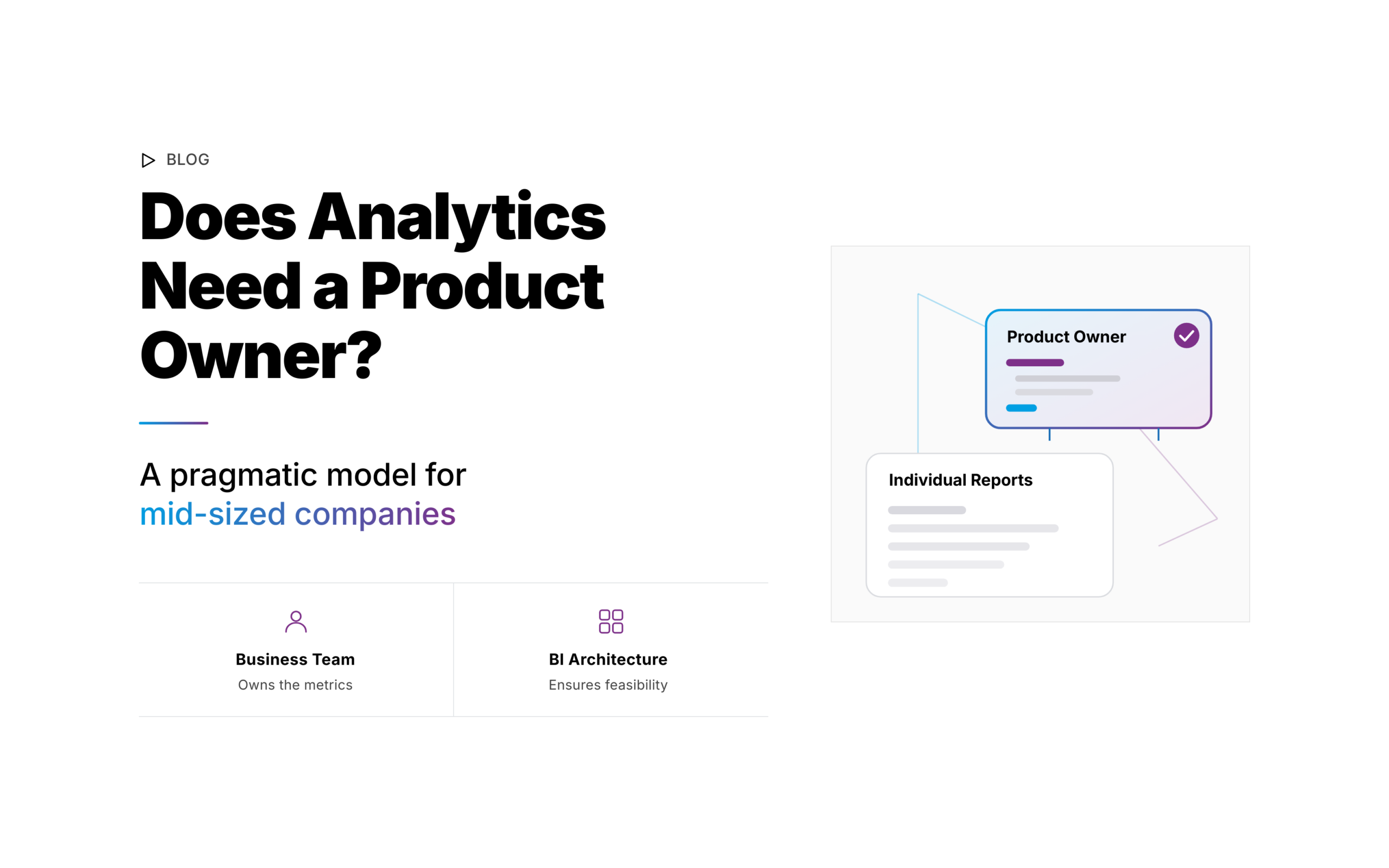
▷ Analytics products instead of individual reports
Instead of 40 isolated reports, “sales management,” for example, is understood as one product, with a clear purpose, defined users, and a single named owner.
▷ The product owner from the business unit
The role is taken on, with a fixed share of their time, by an experienced person from the business unit, such as a controller or sales manager who is already responsible for the key figures anyway.
▷ The tandem with BI architecture
At the Product Owner’s side stands a technical contact, internal or external, who keeps feasibility, data model, and system landscape in view.
▷ A lean backlog with clear rules of the game:
Requirements are prioritized by business value, transparently and traceably for everyone involved.
Technology as the foundation: without shared semantics, no product owner
Even the best product owner remains ineffective if every key figure is calculated differently in three systems. Modern SAP architectures such as SAP Datasphere and SAP Business Data Cloud offer a suitable foundation with a central semantic layer and business-oriented spaces. Key figures are defined once and used the same way everywhere. This anchors the role technically as well, instead of it existing only on the org chart.
Best practices for getting started
1. Start small
Begin with a single, visible analytics product, ideally where the pain from conflicting numbers is greatest.
2. Plan time honestly
Product ownership “on the side” doesn’t work. A firmly reserved share of time is the most important condition for success.
3. Define key figures in a binding way
A shared KPI glossary is the first work product of every product owner and the fastest route to “one version of the truth.”
4. Use migrations as an opportunity
When the move from SAP BW to a modern platform is coming up, that is the ideal time to reorganize responsibilities and deliberately leave legacy burdens behind.
Conclusion
Responsibility beats tools.
Does analytics need a product owner? Yes, but not necessarily as a full-time position. What matters is that for every central key figure, someone with business expertise and a clear mandate takes responsibility. Combined with a clean semantic architecture, this creates an analytics landscape that management and business units trust. Anyone who tailors the role model to their own organization turns reports into a sound basis for strategic decisions.
Author: Daniel Hettich | Last updated: 10/16/2026