
Knowledge & Trends
Data products in the SAP world: substance or just the next data buzzword?

Blog post
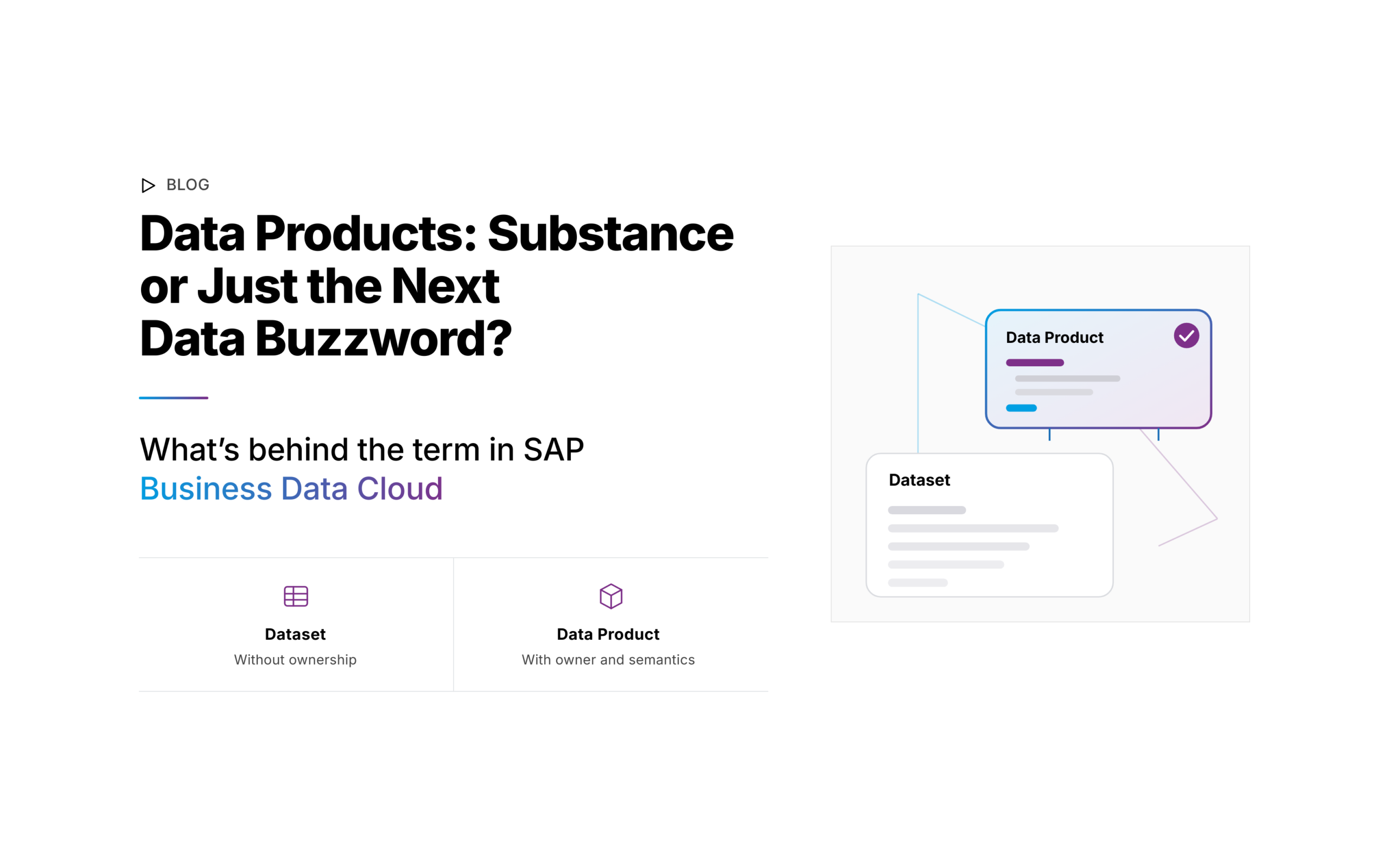
Data warehouse, data lake, lakehouse, data mesh, data fabric: hardly any area of IT produces new buzzwords as reliably as data management. Anyone who has been responsible for reporting and analytics for a few years has learned to be skeptical of every new term at first. And now, data products.
The skepticism is justified, but in this case it falls short. Behind the term is not a new tool, but a shift in perspective. Data is no longer treated as a technical byproduct of processes, but as a product with clear ownership, an understandable description, and reliable quality. Ever since SAP put data products at the center of its data strategy with SAP Business Data Cloud, the topic has been relevant for every SAP company. The key question is therefore not whether data products are coming, but how to introduce them so that real value is created.
The real problem: the data is there, it’s just not usable
In nearly every company we talk to, a similar picture emerges. There is no shortage of data, quite the opposite. The problem is its usability:
1. Three departments, three truths:
Sales, controlling, and executive management report different revenue figures because each department maintains its own extraction, its own filters, and its own Excel logic.
2. Lost semantics
When data is extracted from the ERP, the business context is lost. What remains are cryptic table and field names whose meaning only a few specialists still know.
3. Knowledge silos in BW
BW models that have grown over the years contain valuable business logic, but it is often documented only in the heads of individual developers.
3. AI projects without a foundation
Many AI initiatives fail not because of the algorithm, but because the data is neither findable, nor trustworthy, nor explained in business terms.
This is exactly where data products come in. They don’t solve the storage problem, but the problem of understanding and trust.
What really makes a data product, and what doesn’t
A widespread misunderstanding: a data product is simply a renamed table or an existing view with a new label. If that were so, the term would indeed be just a buzzword. A real data product, however, meets a number of criteria:
▷ Fachliche Semantik
The data is described in the language of the business, including meaning, key figure definition, and relationships to other objects.
▷ Clear responsibility
Every data product has an owner who is accountable for its content, quality, and further development.
▷ Governance by design
Authorizations, data protection, and quality rules are part of the product from the start, not added afterward.
▷ Defined interface
Consumers access the data through standardized, versioned interfaces instead of helping themselves directly to source tables.
▷ Discoverability
Data products are documented in a catalog, so that business units and data scientists know what already exists.
Our rule of thumb from practice: If nobody is responsible for a dataset, it is not a product, but just a dataset with a new name.
SAP data products in practice: from standard to custom development
With SAP Business Data Cloud (BDC), SAP has consistently translated the concept into its architecture. Datasphere, SAP Analytics Cloud, and other components work together there on the basis of data products. For companies, this results in several paths:
1. SAP-managed data products
SAP delivers prefabricated, semantically harmonized data products, above all from SAP S/4HANA, and maintains them itself. Custom extraction pipelines for standard content thereby become unnecessary in many cases.
2. Custom data products
No company works 100% in the standard. Customer-specific fields, individual business logic, or data from non-SAP systems can be turned into custom data products or combined with SAP standard content.
3. Zero-copy instead of data copies
Through open sharing mechanisms, data products can be shared with platforms such as Databricks, Snowflake, or Microsoft Fabric (soon), without the data having to be copied again and maintained separately.
4. Intelligent applications
On the basis of data products, SAP provides ready-made analytics applications that deliver key figures and dashboards without extensive custom development.
As promising as that sounds, the art lies in the details. Which standard data products actually cover your own requirements? Where are extensions needed? And how does the license and cost model relate to the expected benefit? These questions can only be answered with a clean fit-gap analysis, and this is exactly where it is decided whether a project becomes a success.
Best practices for the successful introduction of data products
1. Start with a use case, not with a catalog
Choose a concrete business use case with tangible benefit, such as unified revenue or liquidity reporting, and build the first data products along this need.
2. Anchor ownership in the organizatio
Data products rarely fail because of technology, but because of missing responsibility. Define clear roles for content and quality together with the business units.
3. Check the standard first
Analyze which SAP-managed data products already cover your requirements before you develop your own solutions. This saves development and maintenance effort.
4. Clarify target architecture and costs early
Whether Datasphere, Databricks, or Snowflake, the combination of platforms and the license model should be settled before the project starts.
Conclusion
Substance, if you approach it the right way.
Data products are not an empty buzzword. They address a real and expensive problem: data that exists but is neither understandable, nor trustworthy, nor reusable. With SAP Business Data Cloud, there is for the first time a platform that implements the concept end to end in the SAP environment.
Data products only become a buzzword when companies rename old tables, buy a new tool, and forgo organizational change. Those who instead start with a clear use case, define responsibilities, and set up the architecture thoughtfully create the foundation for reliable analytics, efficient planning, and productive AI, today and in the future.
Author: Daniel Hettich | Last updated: 10/16/2026